
NOSSA ARTE – New perspectives on contemporary Brazilian painting
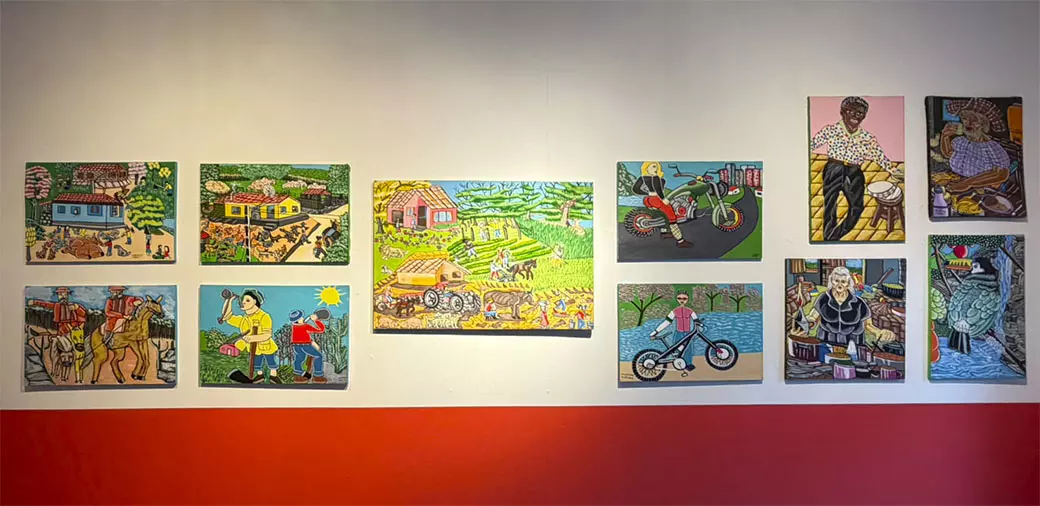
From the outskirts to rural areas: an original exhibition at Z42, in Cosme Velho, reveals other geographies of Brazilian painting
Curated by Fabio Szwarcwald, Paulo Tavares, and Peralta, the exhibition brings together 20 artists from different generations
On September 9, 2026, at 6 p.m., Z42 Arte, in Cosme Velho, will open Nossa Arte — New perspectives on contemporary Brazilian painting, an exhibition that brings together 20 artists from different generations and regions of the country, curated by Fabio Szwarcwald, Paulo Tavares, and Peralta. The show presents works developed, for the most part, outside of traditional spaces for artistic training and legitimation. On view until December 31, this group exhibition gathers diverse ways of thinking about and creating painting in Brazil today.
From Amazonas to Santa Catarina—passing through Pará, Pernambuco, Paraíba, Bahia, Goiás, Mato Grosso, Minas Gerais, São Paulo, and Rio de Janeiro—[states] are participating in the exhibition. Ademilson Felipe, Ágatha Porciúncula, Amomm H. de Deus, Duarte Yanomami, Eli Bacelar, Gê Guevara, Graciete Borges, Helena Rodrigues, José Carlos de Oliveira, Maria José Batista, Matheus Matias, Rhuan, Rodorigo, Seo Antônio Ferreira, Tercília dos Santos, Valques Pimenta, Waldecy de Deus, Wilson dos Santos Formiga, Zayre e Zezim.
These are artists whose works stem from highly distinct experiences and repertoires, and who find in painting a field for exploring daily life, labor, religiosity, popular festivities, and relationships with the territory.
Geographical diversity is one of the principles behind the selection. Nossa Arte It brings together works from the peripheries of large cities, Indigenous communities, inland towns, and rural areas, placing side by side artists who have forged their paths under vastly different circumstances and at different points in time. Some have decades-long careers and have exhibited both in Brazil and abroad, while others are only now beginning to gain visibility.
For the curators, the goal is precisely to challenge the boundaries between so-called “folk art” and contemporary art, questioning the limits that typically separate these two fields. The collection highlights the diverse paths taken by painting in Brazil today—paths shaped by distinct experiences, repertoires, and contexts, and, in many cases, developed outside of conventional artistic training.
“For years, I have sought to get to know artists who work outside the Rio–São Paulo axis. I enjoy spending time with them, visiting their spaces, and understanding how they work. Nossa Arte it also stems from these encounters and the desire to showcase work that reveals the country’s enormous cultural diversity. We need to step out of our bubbles to recognize the creative capacity that exists in so many other Brazilian territories,” says Paulo.
For Peralta, this shift in perspective is central to the exhibition’s premise. “I see this show as an exercise in looking inward. Our greatest wealth lies in our cultural diversity. Too often, we focus our gaze on a single sociocultural axis, which ends up creating a monotonous vision of the country itself.. Nossa Arte It offers a counterpoint by bringing together artists and experiences that rarely appear alongside one another when considering contemporary Brazilian painting. It is worth noting that many of them already have over a decade of consistent output.”
“One of the main goals of the exhibition is to create space for self-taught artists to be seen and recognized for the strength of their work, without conventional artistic training being a parameter to determine their place. These are works deeply connected to each artist's life experiences, their questions, and ways of perceiving the world. By bringing them together, Nossa Arte allows the public to come into contact with different ‘Brazils’ through painting,” says Szwarcwald.
The stories brought together by the exhibition convey the scale of this variety. Ademilson Felipe, a native of São José de Ubá, in the northwest of Rio de Janeiro state, worked in the fields and, after moving to the outskirts of Itaperuna, in the construction industry. It was from this trade that he obtained the first paints he used to create his art—initially applying them to the walls of his own home, and later to scraps of wood and canvases. José Carlos de Oliveira, from Pernambuco, also turned to painting following a life path marked by various trades: he cut sugarcane, worked in a sugar mill and as a construction laborer, performed in a circus, sang serenades, and learned the craft of *mamulengo* (traditional puppet theater) from his father. After years of carving wooden puppets, he began experimenting with paints.
In Bananeiras, Paraíba, Matheus Matias began drawing with charcoal on the walls of his rural home as a child. Deaf, mute, and with progressive visual loss, he made visual creation his main form of expression, covering the interior and exterior walls of his residence with floral motifs, elements of nature, and images of sacred art. Seo Antônio Ferreira, from Mato Grosso, finds the origin of his painting in his childhood. The son of a rural worker, he would observe the clearing of trees for planting and then recreate them in his drawings. Birds, plants, animals, houses, and paths now make up the universe of his canvases.
Other works establish direct relationships with the urban and cultural contexts from which they emerge. Born in the West Zone of Rio, Rhuan In his paintings, he observes the encounter between the urban and the rural in Sepetiba, the neighborhood where he grew up. In the series "Knights of my neighborhood," he follows the daily lives of children for whom horses, games, and tasks of rural life are all part of the same landscape. In the North Zone of Recife, Rodorigo use the festivals and characters of Northeastern folk culture—from the São João celebrations and the Pernambuco Carnival to the Jaraguá and La Ursa—in paintings characterized by thick layers of paint and intense colors.
Among the artists with the longest careers is Eli Bacelar, born in Manaus in 1960. He began exhibiting at the age of 15 and developed a style of painting dedicated to the landscapes, inhabitants, and customs of the Amazon. Tercília dos Santos, from Piratuba, in Santa Catarina, began production in 1990 and draws upon childhood memories of life in the countryside to depict scenes of planting and harvesting, as well as cultural and spiritual practices.
As for Waldecy de DeusBorn in Bahia and based in São Paulo, he has built a career since the late 1960s with exhibitions in Brazil and abroad, with recurring themes including festivals, popular events, religiosity, and everyday Brazilian characters. The exhibition also includes the work of Helena Rodrigues (1947–2026), an artist from Salvador who settled in Rio de Janeiro. A teacher with a degree in piano from UFRJ, Helena developed a style of painting defined by her observation of the culture and daily life of Rio—capturing scenes of Carnival, samba, beaches, religious festivals, and the circus.
Conceived by Paulo Tavares and Fabio Szwarcwald, Nossa Arte It is an initiative of the *Cultura em Conexão* project, in partnership with Galeria Imaginária and A-Ponte. The exhibition is hosted at Z42, a space dedicated to the visual arts located in a 1930s mansion with eclectic architecture in the Cosme Velho neighborhood. Spanning approximately 1,500 square meters, the property houses an exhibition area, artist studios, and an auditorium.
ABOUT THE CURATORS
Fabio Szwarcwald is an economist who graduated from UERJ, holding an MBA in Finance from IBMEC and in Business Management from FGV. After 22 years working in the financial sector, he shifted his focus toward management and projects within the fields of art, culture, and technology. He served as director of the Escola de Artes Visuais do Parque Lage from 2017 to 2019, and as executive director of MAM Rio from 2020 to 2022. He is the founder of A-Ponte—an organization dedicated to projects at the intersection of art, education, and technology—and is the creator and executive director of the *Arte nas Estações* (Art in the Stations) project. He is a member of the New Museum’s International Leadership Council in New York, the Osesp Advisory Board, the Rio de Janeiro City Council, and the strategic committee of Oi Futuro. He also serves as a visual arts columnist for *Veja Rio*.
Paulo Tavares is from Rio de Janeiro, a researcher and collector. He holds a degree in Engineering from PUC-Rio, and postgraduate degrees in Administration from FGV-Rio, Art History from Universidade Candido Mendes, and Curatorship from ZAIT. In 2019, he conceived GIM — Galeria Imaginária. He participated in the conception of Prosperidade, Felicidade em Tudo, at Museu do Pontal (2022), and held exhibitions such as Por Tudo Aquilo que nos Representa (Casa Bicho, 2022), Bruta Poesia, the first solo exhibition by José Bezerra—an artist from Pernambuco—in Rio de Janeiro (Universidade Candido Mendes, 2023), Ensaio Aberto, by Marcelo Conceição (Tropigalpão, 2025), and De onde eu venho (Tropigalpão, 2026), a group exhibition that brought together 12 folk artists from the five Brazilian regions.
Peralta is a resident of Santa Cruz, a curator and social scientist in training at Colégio Pedro II, as well as a researcher at the Carolina Maria de Jesus Black and Indigenous Collective. He has curated exhibitions such as 40 anos iniciais do ensino fundamental do Colégio Pedro II (Teatro Mário Lago, 2024), BAILE (Galeria Ocupá, 2025), OBIRIKITI (Sesc São Gonçalo, 2025), Alvorada (Dutra Gallery, 2025) e De onde eu venho (Tropigalpão, 2026). He was also an artist-in-residence at cultural facilities within Colégio Pedro II, expanding their work at the intersection of territory, education, and curatorial practices.
SERVICE:
Nossa Arte — New perspectives on contemporary Brazilian painting
Curated by: Paulo Tavares and Peralta
Initiative: Paulo Tavares and Fabio Szwarcwald
Opening: September 9, 2026, from 6:00 PM to 9:00 PM
Closing: December 31, 2026
Local: Z42 Arte
Rua Filinto de Almeida, nº 42
Cosme Velho | Rio de Janeiro
Visiting hours: Wednesday to Saturday, from 11 a.m. to 7 p.m.
Free admission | open to all ages
Further information for the press:
Mônica Villela Companhia de Imprensa
(21) 97339-9898 | [email protected]